
Overview
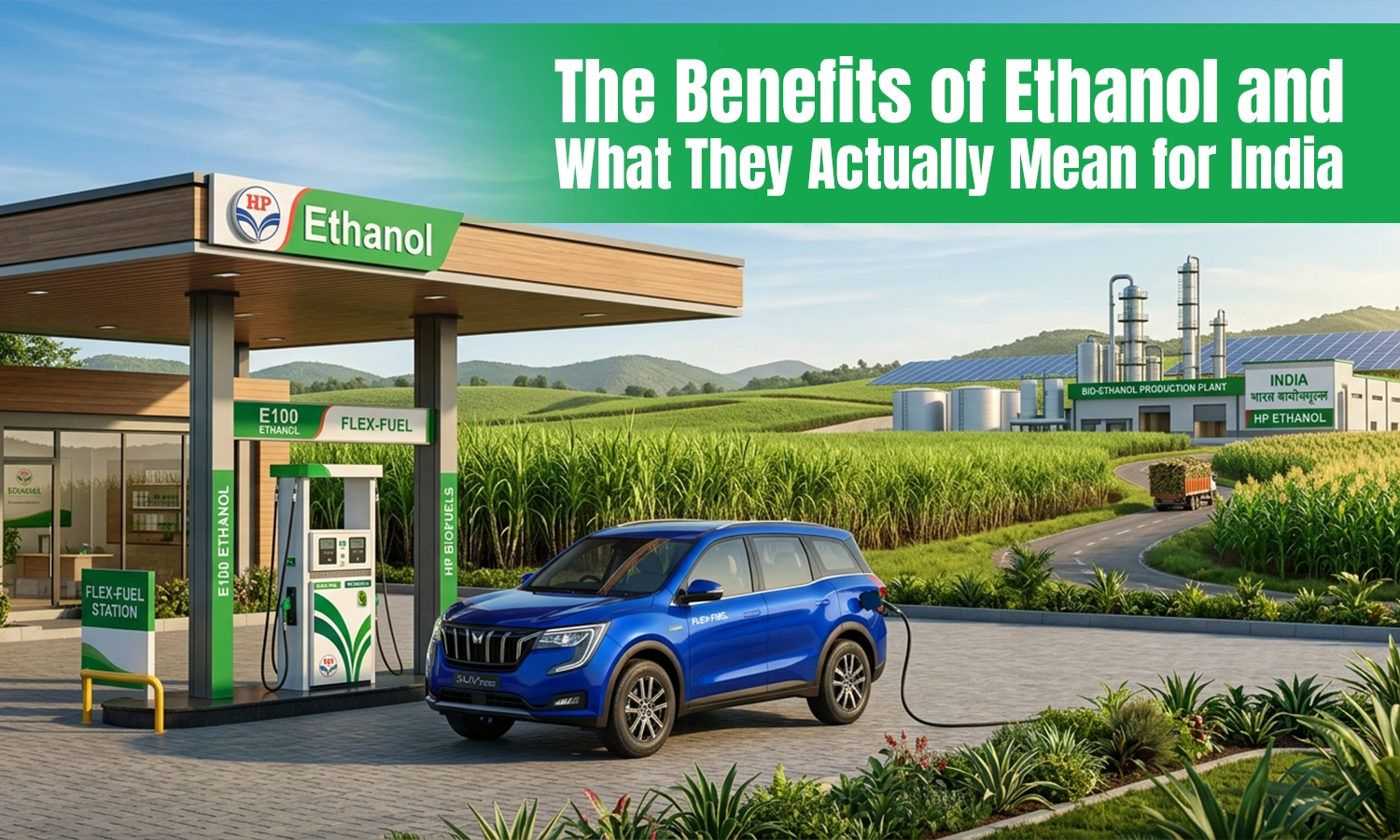
India hit E20 ahead of schedule. That single line hides a much larger story about money leaving the country, money reaching farmers, and air quality in cities.
This piece sets out what ethanol has already delivered, what the recent wave of policy notifications opens up next, and why the industry is now looking well beyond the petrol pump.
Why This Matters More Now Than It Did Five Years Ago
India spends an enormous sum importing the energy that moves it, with the fossil fuel import bill running in the region of ₹22 lakh crore a year. Every litre of ethanol blended into petrol is a litre that does not have to be bought in dollars from somewhere else.
That is the simplest way to understand the benefits of ethanol. It is a fuel India grows rather than imports. Everything else follows from that one fact.
Energy Security and a Lighter Import Bill
The strategic case for ethanol blending is straightforward. A country that manufactures a meaningful share of its own transport fuel is less exposed to crude price shocks, shipping disruptions and geopolitical pressure it does not control.
At the AIDA Annual Distillers' Conclave, Sanjeev Chopra, Secretary in the Department of Food and Public Distribution, pointed to the current upswing in crude prices as making the case for accelerating bioenergy clearer than ever. When crude climbs, domestically produced ethanol stops being an environmental preference and becomes an economic shield.
A Second Income Stream for the Indian Farmer
The most underrated of the benefits of ethanol is what it does to farm economics.
A sugarcane or maize grower selling into the ethanol chain has a second, assured buyer. That changes the negotiating position at the mill gate and puts a floor under prices in a way that no advisory or announcement ever could.
The feedstock story has also broadened. The All India Distillers Association’s data shows maize has emerged as the single largest feedstock for ethanol production in India, moving ahead of traditional sugarcane-based sources. Cumulative supplies crossed 515 crore litres in the first half of the 2025-26 Ethanol Supply Year. Damaged and surplus grain that has no premium food market is absorbed into the system rather than wasted.
Cleaner Air and Lower Emissions
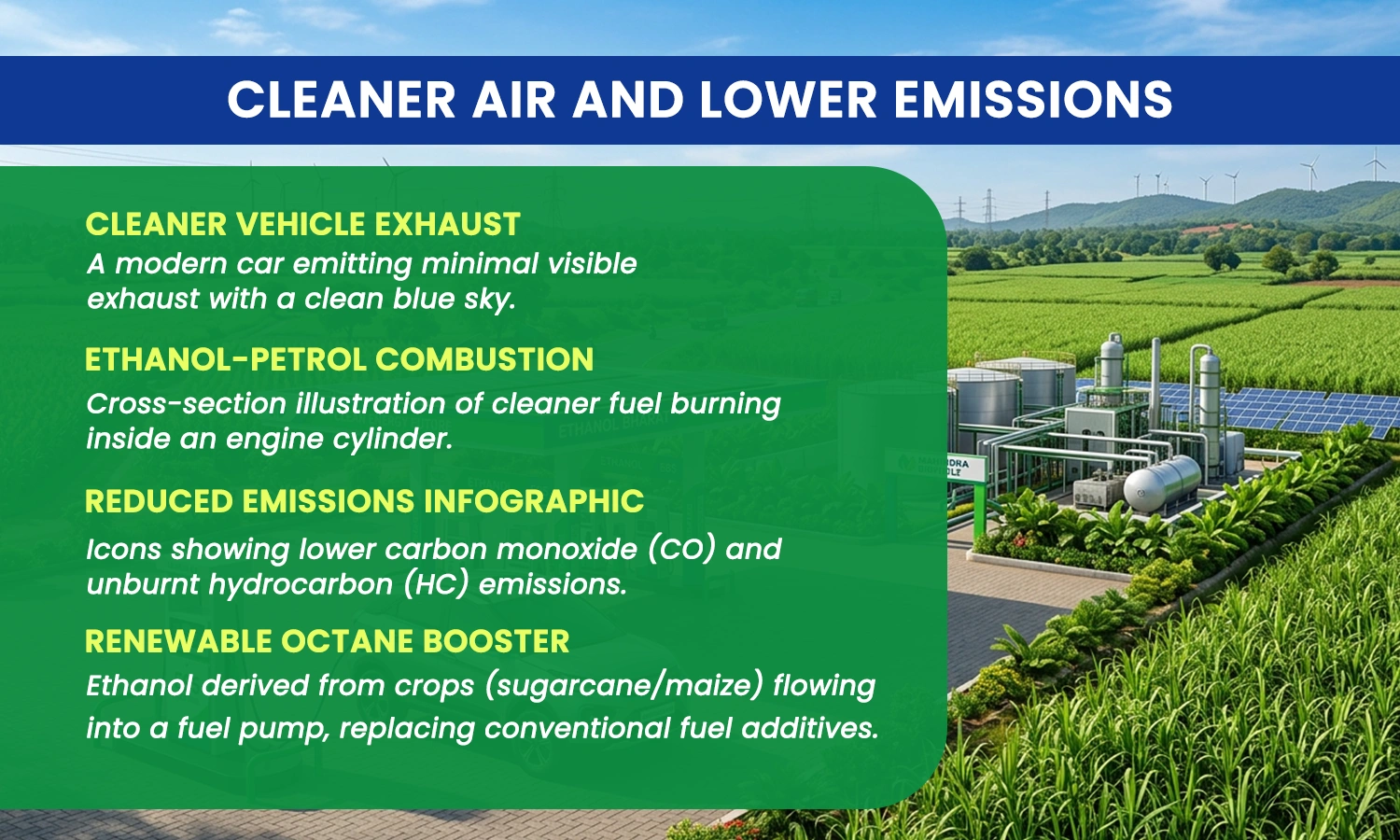
Ethanol is an oxygenate. It carries oxygen inside the fuel molecule, which supports more complete combustion and reduces carbon monoxide and unburnt hydrocarbon emissions at the tailpipe. Ethanol also replaces older octane boosters with a renewable alternative.
Because the crop absorbs carbon dioxide while growing, the lifecycle carbon position of ethanol fuel in India is materially better than that of the fossil petrol it displaces. This is the quiet, compounding return on benefits of ethanol blending in petrol, delivered across crores of vehicles every single day.
A Fuel India Actually Has in Surplus
Here is the fact that reframes the entire conversation. India's distilling industry has built a capacity of roughly 2,000 crore litres, against utilisation running nearer 1,200 crore litres.
The country is not short of ethanol. It has more than it currently uses. That surplus is an asset, and it is precisely why the industry has pushed the government to open new demand rather than build new supply.
Speaking at the AIDA Annual Distillers' Conclave, Association President Vijendra Singh made the point plainly, noting that the technology and the infrastructure are already in place and that there is no reason blending cannot rise to thirty percent.
Beyond Petrol. Aviation, Cooking, and Flex Fuel Mobility
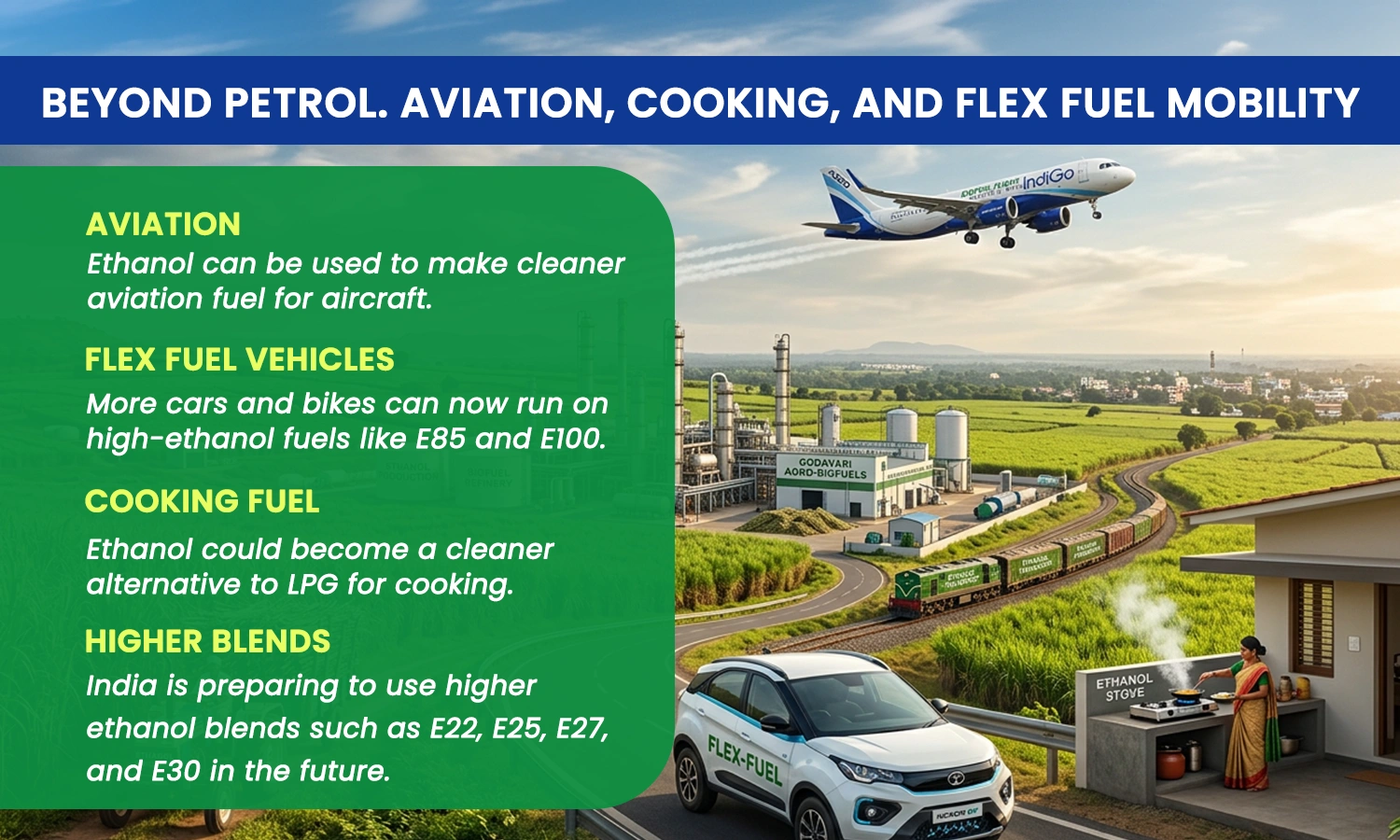
The next chapter of ethanol as fuel in India reaches well past the petrol pump.
- Aviation. The alcohol to jet pathway has been approved, allowing ethanol-derived sustainable aviation fuel to be blended into aviation turbine fuel under ASTM D7566 certification.
- Flex fuel mobility. E85 and E100 have been given legal recognition through amendments to the Central Motor Vehicles Rules, opening the road for flex fuel vehicles from both four-wheeler and two-wheeler manufacturers.
- Cooking fuel. AIDA has written to the Ministry of Petroleum and Natural Gas urging a nationwide rollout of ethanol-based cooking as an alternative to LPG.
- Higher blends. The Bureau of Indian Standards has notified specifications for E22, E25, E27, and E30, clearing the technical path beyond twenty percent.
The Price Advantage at the Pump
Higher ethanol blends carry less energy per litre, so efficiency falls as the blend rises. The policy answer has been to price the difference away. E85 has been signalled at roughly twenty rupees per litre below petrol.
That gap is a deliberate signal. It tells the market that the government intends to accelerate the transition to cleaner fuel rather than let a mileage argument stall it, and it puts the benefits of ethanol directly into the pocket of the person filling the tank.
The Benefits at a Glance
|
Benefit |
What It Delivers |
Energy security |
Every blended litre displaces imported crude, cutting exposure to price shocks and forex outflow against a fuel import bill near ₹22 lakh crore. |
Farmer income |
A second assured buyer for cane and maize growers, putting a floor under farm gate prices. |
Cleaner air |
Ethanol is an oxygenate, supporting more complete combustion and lower carbon monoxide and hydrocarbon emissions. |
Lower lifecycle carbon |
The feedstock absorbs carbon dioxide while growing, improving the carbon position against fossil petrol. |
Industrial capacity in place |
Roughly 2,000 crore litres of built capacity, with headroom already available. |
Rural employment |
Jobs across cultivation, procurement, distillation, logistics and by-product processing. |
New demand frontiers |
Sustainable aviation fuel, flex fuel vehicles, cooking fuel and diesel blending. |
Consumer savings |
E85 was priced at roughly ₹20 per litre below petrol. |
Key Takeaways
- The core of the benefits of ethanol is simple. India grows this fuel rather than importing it.
- E20 was reached ahead of target, and BIS has already notified standards through E30.
- Maize has overtaken sugarcane as India's largest ethanol feedstock, with supplies crossing 515 crore litres in the first half of ESY 2025-26.
- Built capacity near 2,000 crore litres against utilisation nearer 1,200 crore litres means the headroom already exists.
- Aviation fuel, flex fuel vehicles and ethanol cooking are the next demand frontiers.
- E85, priced roughly ₹20 below petrol, turns an environmental choice into an economic one.
Frequently Asked Questions
What are the main benefits of ethanol blending in petrol?
Reduced dependence on imported crude and the forex that goes with it, a second income stream for farmers, lower tailpipe emissions, and a better lifecycle carbon position than fossil petrol.
Does ethanol blending help farmers directly?
Yes. It creates an assured second buyer for sugarcane and maize growers, which strengthens their position at the mill gate and supports prices. Damaged and surplus grain also finds a use.
How much ethanol can India actually produce?
Built capacity stands at roughly 2,000 crore litres, while utilisation has been running at around 1,200 crore litres. The country has more capacity than it currently uses.
Is ethanol only used in petrol?
No. The alcohol to jet pathway has been approved for ethanol-based sustainable aviation fuel, E85 and E100 now carry legal recognition for flex fuel vehicles, and ethanol-based cooking is under active consideration as an LPG alternative.
Will higher ethanol blends cost me more at the pump?
The pricing has been designed to work the other way. E85 has been signalled at roughly twenty rupees per litre below petrol, offsetting the lower energy content of the blend.
The fuel India grows. The body that has represented it since 1953.
The All India Distillers' Association is the apex national body for India's ethanol and distillery sector, and the only association recognised by the Government of India representing grain-based and molasses-based ethanol producers alongside potable alcohol manufacturers.
For verified production data, policy briefings and the industry's roadmap beyond E20, visit aidaindia.org.