
Introduction :
The price of petrol in India is never the same everywhere. A litre of fuel in Delhi can cost much less than the same litre in Hyderabad or Mumbai. Many people assume that this difference comes only from crude oil prices. In reality, taxes are one of the biggest reasons behind the variation.
The biggest factor is VAT on petrol. Since petrol is still outside the GST system, every state government decides its own tax structure. This changes the final retail price paid by consumers.
India also imports more than 85% of its crude oil requirement. Global crude prices, transportation costs, dealer commissions, and currency fluctuations further affect pricing. Together, these factors decide how much consumers pay at fuel stations.
Why Petrol Prices Change Across States
The main reason behind different fuel prices is the state tax on petrol. Every state has different revenue needs and policy priorities. Some states charge VAT as a percentage, while others add fixed cesses along with percentage-based taxation.
For example, Telangana charges one of the highest VAT rates in the country at around 35.20%, while Tamil Nadu follows a different structure with 13% VAT plus a fixed amount per litre. Andhra Pradesh remains among the most expensive states for petrol pricing.
Transportation also matters. Petrol has to move from refineries and depots to retail outlets across India. States located far from ports or refineries usually face higher freight costs.
Dealer commissions and local levies further add to the final price. Some cities even have separate municipal charges, which create price differences within the same state.
The Role of VAT in Petrol Pricing
VAT on petrol is one of the largest contributors to fuel prices in India. Unlike GST, VAT is controlled individually by state governments.
Most states apply VAT as an ad valorem tax. This means the tax is calculated as a percentage of the fuel’s total value. The calculation usually includes:
Base fuel price
Freight charges
Dealer commission
Central excise duty
This creates a cascading effect because VAT is charged on top of other taxes.
The petrol VAT rate differs sharply across India. Union Territories such as Andaman & Nicobar have among the lowest prices, while Andhra Pradesh and Telangana remain at the higher end.
Here is a quick look at approximate petrol prices in May 2026:
| State/City | Approx Petrol Price |
| Andaman & Nicobar | ₹82.46 |
| Delhi | ₹96.72 |
| Mumbai | ₹103.54 |
| Chennai | ₹100.84 |
| Hyderabad | ₹107.50 |
| Andhra Pradesh | ₹109.21 |
This variation is why many consumers search for the latest VAT rate list before comparing fuel prices.
Central vs State Taxes on Petrol
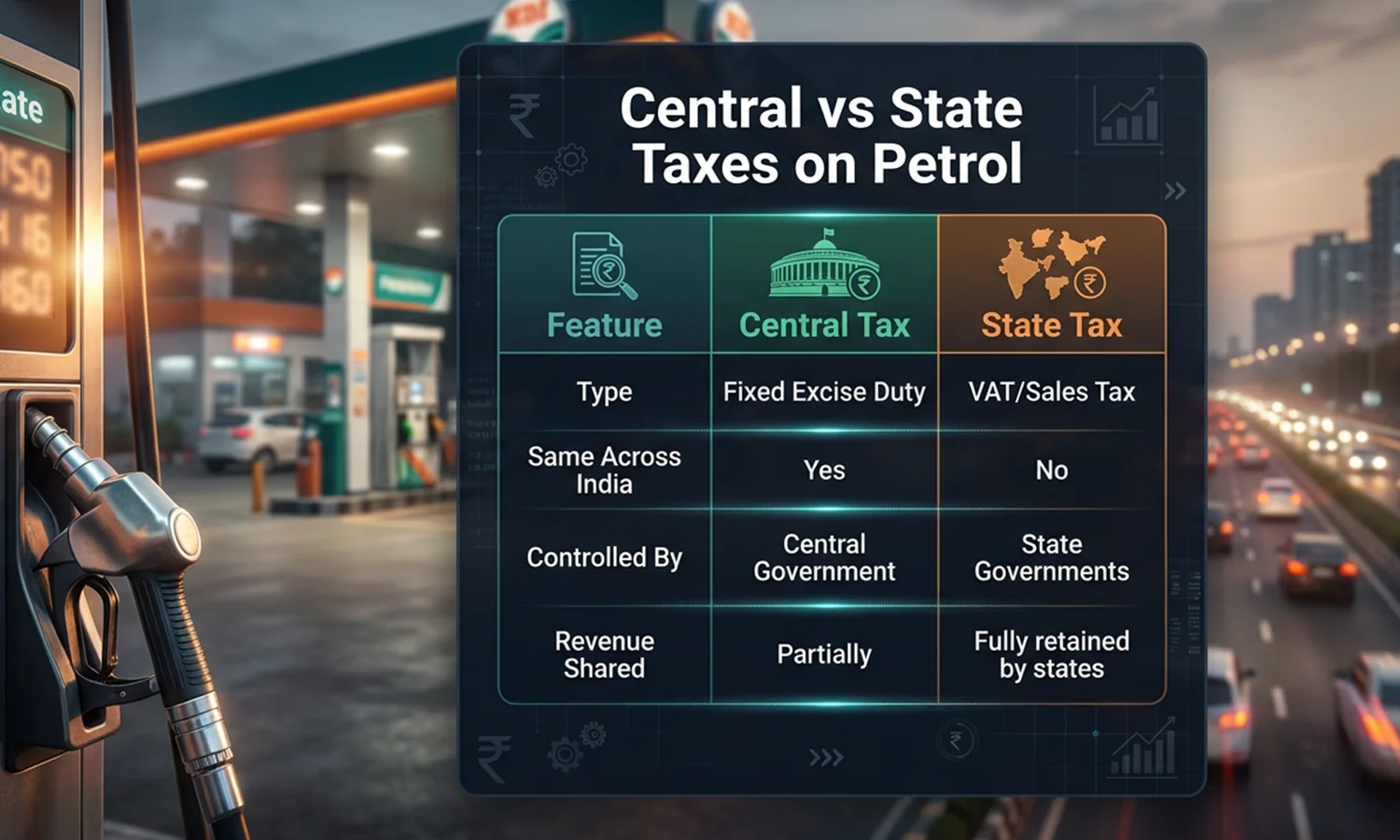
Both the Centre and states impose taxes on petrol, but their methods are different.
The central government tax on petrol comes through excise duty. This is usually fixed across the country. As of March 2026, the Centre reduced the Special Additional Excise Duty from ₹13 to ₹3 per litre to control inflation.
State governments apply VAT separately. Since this tax is percentage-based in most regions, the total amount collected rises whenever fuel prices increase.
This is why people often ask how much tax on petrol in India actually goes to the Centre and how much remains with the states.
Here is a simple comparison:
| Feature | Central Tax | State Tax |
| Type | Fixed Excise Duty | VAT/Sales Tax |
| Same Across India | Yes | No |
| Controlled By | Central Government | State Governments |
| Revenue Shared | Partially | Fully retained by states |
The central govt tax on petrol provides national revenue while state VAT supports local infrastructure, welfare schemes, and public spending.
Why Petrol Is Still Outside GST
One of the biggest debates in fuel pricing is the petrol GST rate question.
Petrol and diesel remain outside GST because fuel taxes are a major source of income for both central and state governments. For several states, petroleum taxes contribute nearly 25–30% of total tax revenue.
If petrol moved under GST, the total tax burden would likely fall sharply. Many experts believe prices could be reduced by ₹15–₹25 per litre depending on the GST slab.
At the same time, states would lose independent control over VAT rates. This is one reason the GST Council has still not finalised petrol inclusion.
The discussion around the petrol GST rate, state and central taxation continues because businesses would benefit from the Input Tax Credit if fuel enters GST.
Natural gas and Aviation Turbine Fuel are currently being discussed as possible test cases before petrol is considered.
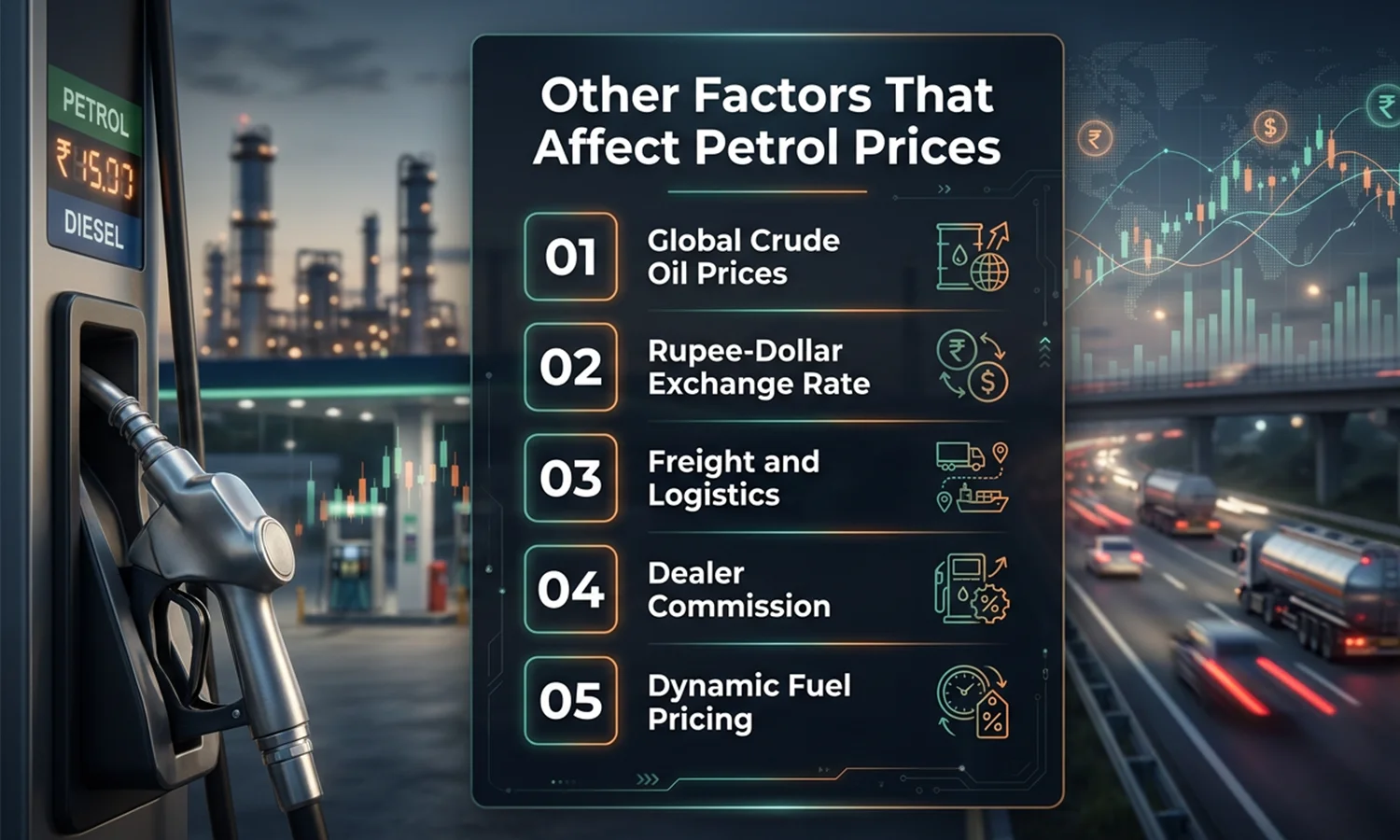
Other Factors That Affect Petrol Prices
Taxes are important, but they are not the only reason fuel prices rise.
Global Crude Oil Prices
India imports most of its crude oil. Any geopolitical tension in major oil-producing regions directly affects domestic fuel prices.
As of May 2026, Brent crude was trading near $104 per barrel due to supply disruptions and global tensions.
Rupee-Dollar Exchange Rate
Oil is purchased in US Dollars. If the Indian Rupee weakens, importing crude becomes more expensive.
In May 2026, the Rupee touched around ₹95.25 against the Dollar, increasing pressure on fuel pricing.
Freight and Logistics
Transporting fuel from refineries to inland depots adds extra cost. Hilly and landlocked regions usually face higher logistics expenses.
Dealer Commission
Petrol pump dealers receive commissions to cover salaries, electricity and operational costs. This is usually around ₹3.87–₹4 per litre.
Dynamic Fuel Pricing
Fuel prices are revised every morning at 6 AM using a 15-day rolling average of global fuel prices.
What High Petrol Taxes Mean for Consumers
The tax on petrol affects much more than just transport costs.
Higher fuel prices increase the cost of moving goods across the country. This affects vegetables, milk, groceries and manufactured products.
Consumers also spend more on daily travel, leaving less disposable income for other expenses.
Businesses face higher logistics costs, which increase the overall cost of doing business in India.
At the same time, fuel taxes remain an important source of revenue for governments. The money collected helps fund highways, welfare schemes and infrastructure projects.
This creates a difficult balance between consumer affordability and government revenue.
Key Takeaways
VAT on petrol is the main reason fuel prices differ across Indian states.
Petrol remains outside GST, allowing states to independently decide VAT rates.
Global crude prices, freight costs, and the Rupee-Dollar exchange rate also affect fuel prices.
The petrol tax in India's structure includes both the central excise duty and the state VAT.
Bringing petrol under GST could lower prices but may reduce government revenue significantly.
Conclusion
Fuel pricing in India is shaped by taxation, global crude markets and local logistics. The biggest factor remains VAT on petrol, since each state follows its own pricing structure.
The ongoing discussion around GST inclusion, excise duty cuts, and state taxation reflects the larger challenge of balancing affordability with revenue generation.
As India continues to expand infrastructure and energy demand rises, the debate around fuel taxation and pricing will remain important for consumers, businesses and policymakers alike.
FAQs
Why does petrol cost more in some states?
The biggest reason is the state tax on petrol. Every state charges a different VAT rate. Freight costs, local taxes, and dealer commissions also affect pricing.
What is the current petrol GST rate in India?
There is currently no official petrol GST rate because petrol is still outside the GST system. Taxes are collected through excise duty and state VAT.
How much tax is included in petrol prices?
A large part of the retail price comes from taxes. This includes the central government tax on petrol and state VAT, which together can account for more than half of the pump price in some states.
Why is petrol outside GST?
States depend heavily on fuel taxes for revenue. Bringing petrol under GST could reduce earnings for both states and the Centre.
Which state has the highest petrol price in India?
As of May 2026, Andhra Pradesh remains among the states with the highest petrol prices due to high VAT and additional cesses.