
Overview
Search for the ethanol formula and you will usually find five simple characters: C2H5OH. While it may look like a basic chemistry concept, this small molecule has become one of the most important building blocks of India's ethanol economy.Today, ethanol powers vehicles, supports industrial manufacturing, enables pharmaceutical applications and contributes to India's growing biofuel ecosystem. From fuel stations and distilleries to laboratories and hospitals, the same molecule continues to play a vital role across multiple sectors.
As the apex national body representing India's distillery sector since 1953,the All India Distillers Association (AIDA)has witnessed ethanol evolve from a traditional industrial and potable alcohol product into a strategic component of India's energy transition. The growing adoption of ethanol blending, expansion of production capacity and emergence of flex-fuel technologies have all brought greater attention to a molecule that many people first encounter in a chemistry textbook.
Understanding the ethanol formula is therefore more than an academic exercise. It is the first step towards understanding why ethanol matters to India's future.
The ethanol formula is commonly written as C₂H₅OH, although it can also be expressed as C₂H₆O. Both forms describe the same molecule consisting of:
- Two carbon atoms
- Six hydrogen atoms
- One oxygen atom
Chemists generally prefer writing C₂H₅OH because it clearly highlights the hydroxyl group (OH), which is the defining feature of alcohols.
This hydroxyl group is responsible for many of ethanol's most important properties. It influences how the molecule interacts with water, how it behaves as a solvent and how it participates in chemical reactions.
In simple terms, when people ask "What is ethanol?", they are referring to a molecule whose unique characteristics are largely determined by this hydroxyl group.
The ethanol formula may appear simple, but it forms the foundation for applications that range from pharmaceuticals and sanitisers to industrial chemicals and transportation fuels.
Why the Hydroxyl Group Matters?
The hydroxyl group is what separates ethanol from hydrocarbons such as ethane.
Without the hydroxyl group, ethanol would behave very differently. It would not mix effectively with water, it would lose many of its solvent properties and it would not serve the broad range of applications that make it valuable today.
This single oxygen-hydrogen combination gives ethanol its identity as an alcohol and contributes significantly to its versatility.
Physical Properties Linked to the Ethanol Formula
Several important physical characteristics can be traced directly to the structure represented by the ethanol formula:
- Molecular Weight: Approximately 46 g/mol
- Boiling Point: Around 78°C
- Density: Approximately 0.789 g/mL
- Appearance: Clear, colourless liquid
- Solubility: Completely miscible with water
These properties explain why ethanol is widely used in both industrial and commercial applications.
Understanding the Ethanol Structure
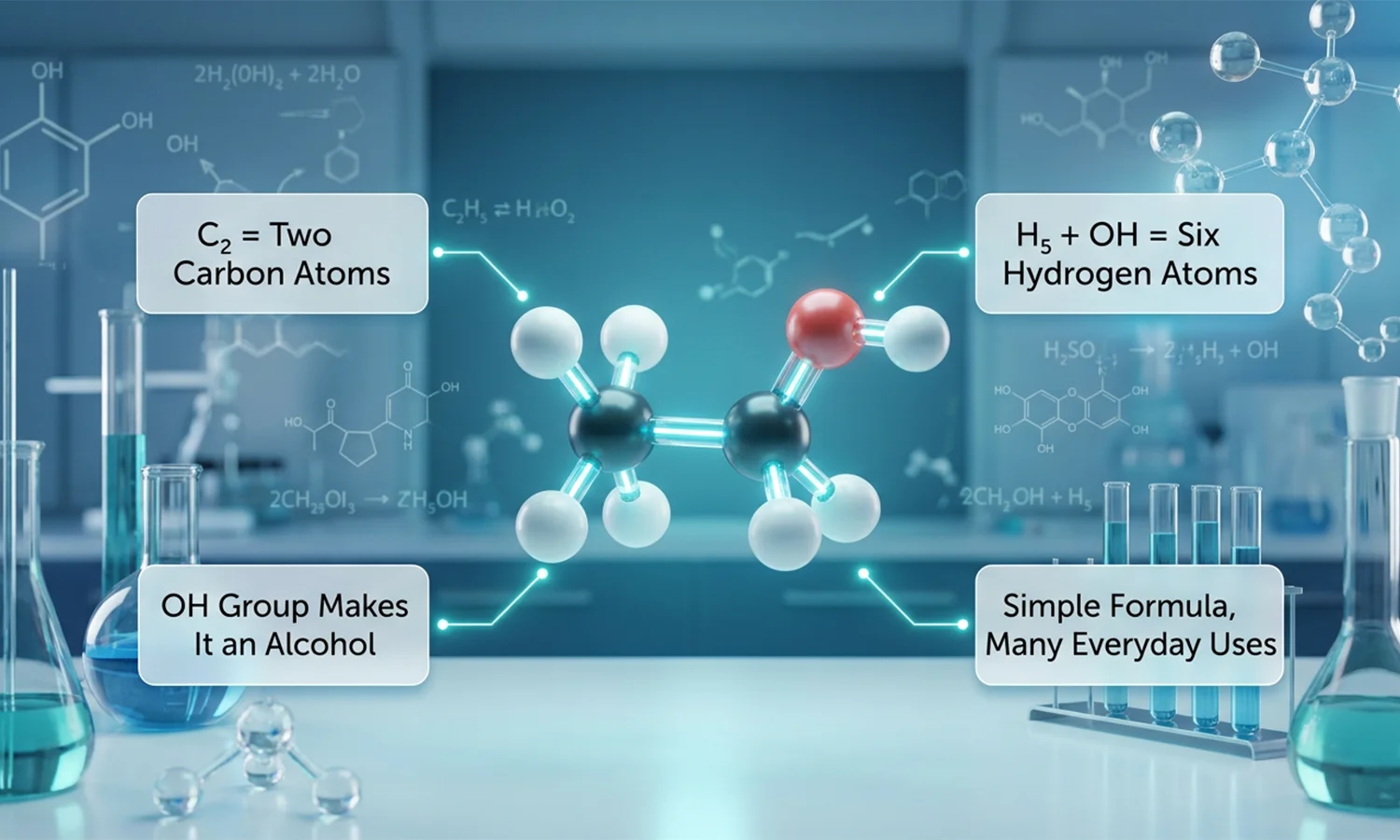
While the ethanol formula tells us which atoms are present, the ethanol structure shows how those atoms are connected.
The structure is commonly represented as:
CH₃ – CH₂ – OH
In this arrangement:
- The first carbon forms a CH₃ group
- The second carbon forms a CH₂ group
- The hydroxyl group (OH) is attached to the end of the chain
This simple arrangement gives ethanol a unique balance of properties that few molecules can match.
The Two Sides of the Ethanol Structure
One reason the ethanol structure is so important is that it contains two distinct regions.
The carbon chain behaves similarly to hydrocarbons and interacts well with oils, fuels and other organic compounds. The hydroxyl group, meanwhile, interacts strongly with water.
This combination allows ethanol to bridge two worlds. It can dissolve substances that mix with water while also interacting with fuels and other organic materials.
This characteristic explains why ethanol is widely used as:
- A solvent in pharmaceuticals
- A carrier in cosmetics and perfumes
- A fuel additive
- A cleaning agent
- A chemical intermediate
How the Ethanol Structure Supports Fuel Applications?
The growing importance of ethanol fuel in India is closely linked to the molecule's structure.
Because ethanol contains oxygen within its molecular structure, it can support cleaner combustion when blended with petrol. This characteristic has made ethanol a key component of India's ethanol blending programme, which achieved approximately 20% blending during Ethanol Supply Year 2024–25.
As India continues expanding its biofuel ecosystem, understanding the ethanol structure helps explain why this molecule has become such an important part of the country's energy strategy.
For AIDA and its member distilleries, the science represented by C₂H₅OH is no longer confined to laboratories. It is now directly connected to India's efforts to strengthen energy security, support agricultural value chains and reduce dependence on imported fuels.
Why the Ethanol Formula Matters Beyond Chemistry?
For decades, the ethanol formula was primarily associated with chemistry classrooms, laboratories and industrial manufacturing. Today, however, ethanol has become a strategic resource that plays an increasingly important role in India's energy, agricultural and industrial sectors.
The same molecule represented by C₂H₅OH is now blended into petrol across the country through India's ethanol blending programme. What was once viewed largely as an industrial alcohol has evolved into a key contributor to energy security and cleaner mobility.
India's achievement of approximately 20% ethanol blending during Ethanol Supply Year 2024–25 marked a significant milestone in the country's biofuel journey. This progress has been supported by growing distillation capacity, improved feedstock availability and continued policy support for ethanol production and adoption.
As the apex body representing India's distillery sector, AIDA has closely followed this transformation and continues to support initiatives that strengthen the ethanol ecosystem. From industry engagement to policy discussions, AIDA remains committed to advancing awareness and understanding of ethanol's role in India's future.
Anhydrous Ethanol and Fuel Applications
Not all ethanol is used in the same form.
For fuel applications, ethanol must first be converted into anhydrous ethanol, a highly purified form that contains minimal water content. Typically, anhydrous ethanol contains at least 99.5% ethanol, making it suitable for blending with petrol.
This additional purification step is essential because water and petrol do not mix effectively. Even small amounts of water can affect fuel stability and performance.
Today, anhydrous ethanol is used in:
- E20 fuel blends
- Fuel ethanol production
- Transport-grade ethanol supply
- Flex-fuel vehicle applications
- Future higher-blend ethanol programmes
As discussions continue around higher ethanol blends and alternative fuel technologies, anhydrous ethanol remains one of the most important products produced by India's distillery sector.
The growing demand for fuel-grade ethanol also reflects the increasing role of ethanol in India's broader energy strategy.
Denatured Ethanol and Industrial Applications
Another important category is denatured ethanol.
Although it shares the same ethanol formula and ethanol structure, denatured ethanol contains additives that make it unsuitable for human consumption.
The purpose of denaturing is not to change the chemistry of ethanol, but rather to ensure it is used for industrial and commercial applications.
Common applications include:
- Industrial solvents
- Paints and coatings
- Cleaning products
- Chemical manufacturing
- Fuel applications
- Laboratory use
The underlying molecule remains C₂H₅OH, but its intended use differs significantly from potable alcohol.
For India's distillery industry, the ability to serve multiple markets through different grades of ethanol highlights the versatility of this single molecule.
Where the Ethanol Formula Appears in Everyday Life?
Once you recognise the ethanol formula, it becomes surprisingly easy to spot ethanol in everyday products.
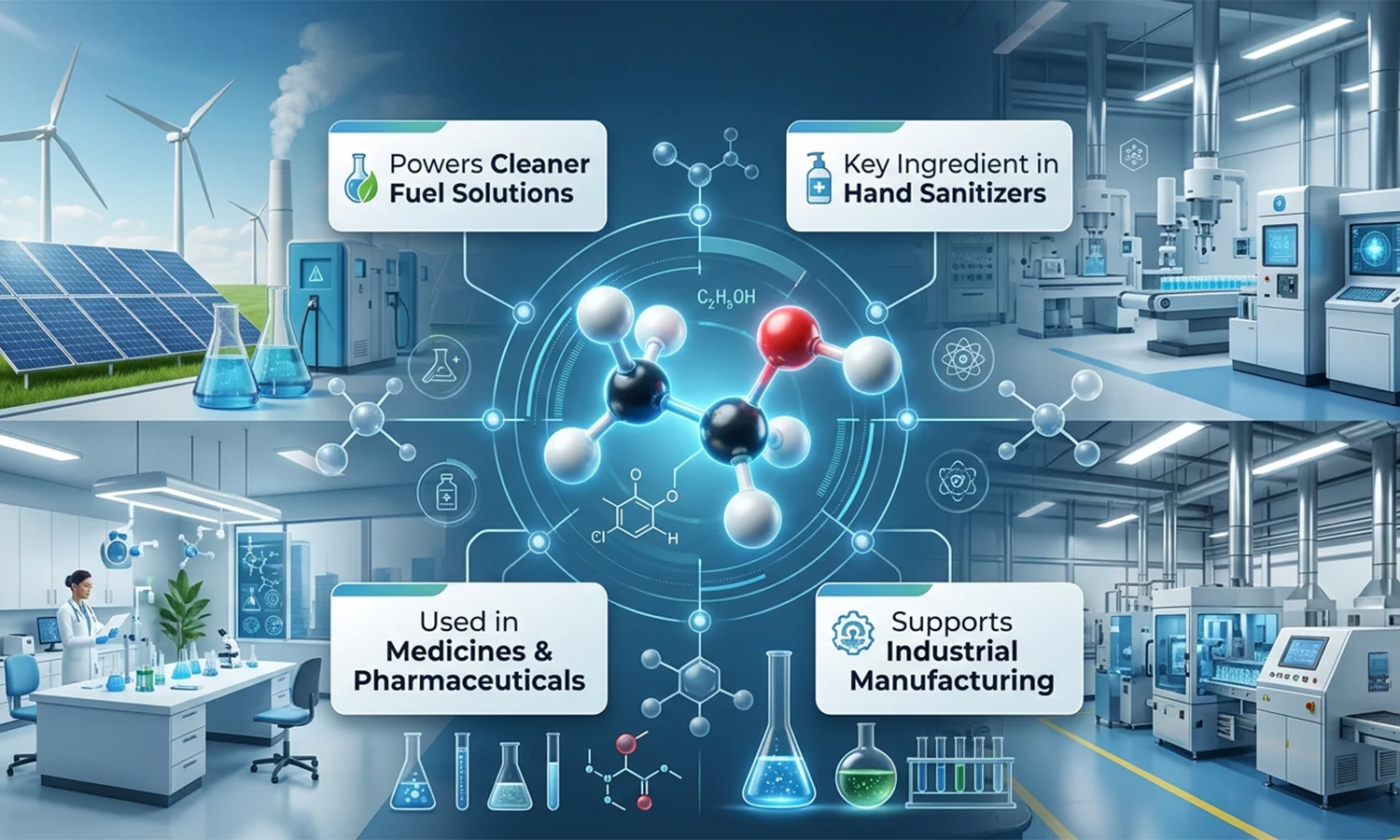
The same molecule appears in:
- Hand sanitisers
- Antiseptic solutions
- Pharmaceutical formulations
- Perfumes and cosmetics
- Industrial solvents
- Paints and coatings
- Fuel blends
- Potable alcohol products
This wide range of applications is one reason ethanol has become such an important product for the global economy.
In India, the growing emphasis on ethanol blending has increased public awareness of ethanol's role beyond traditional industrial and beverage applications. Many people now encounter ethanol every time they visit a fuel station, often without realising the science behind it.
For AIDA's member distilleries, this versatility demonstrates how a single molecule can support industries ranging from healthcare and manufacturing to transportation and energy.
Why Understanding Ethanol Matters Today?
The importance of ethanol today extends far beyond chemistry.
India's growing focus on biofuels, cleaner mobility and energy security has transformed ethanol into a strategic national resource. Discussions around E20, flex-fuel vehicles and future higher-blend fuels all begin with understanding the science behind C₂H₅OH.
At the same time, ethanol supports agricultural value chains by creating demand for feedstocks such as sugarcane, maize and other crops used in ethanol production.
As India's ethanol ecosystem continues to evolve, awareness and understanding of ethanol become increasingly important for policymakers, industry stakeholders and consumers alike.
For more than seven decades, AIDA has represented the interests of India's distillery sector and has witnessed the evolution of ethanol from a traditional industrial product into a key contributor to India's biofuel ambitions.
Behind every blending milestone, production expansion and fuel innovation stands the same molecule:
C₂H₅OH.
Key Takeaways
- The ethanol formula is C₂H₅OH, also written as C₂H₆O.
- The hydroxyl group (OH) is responsible for ethanol's alcohol properties.
- The ethanol structure is represented as CH₃–CH₂–OH.
- Ethanol is widely used in fuel, pharmaceuticals, industrial manufacturing and potable alcohol production.
- Anhydrous ethanol is used for fuel blending, while denatured ethanol is primarily used in industrial applications.
- Ethanol plays a significant role in India's growing biofuel ecosystem.
- AIDA represents more than 80% of India's distillation capacity and continues to support the growth of the country's ethanol sector.
Frequently Asked Questions
What is the ethanol formula?
The ethanol formula is C₂H₅OH. It can also be written as C₂H₆O. The molecule contains two carbon atoms, six hydrogen atoms and one oxygen atom.
What is the ethanol structure?
The ethanol structure is represented as CH₃–CH₂–OH. It consists of an ethyl group attached to a hydroxyl group, which gives ethanol its alcohol properties.
What is the difference between ethanol and methanol?
Ethanol has the formula C₂H₅OH and is widely used in fuel, industrial applications and beverages. Methanol has the formula CH₃OH and is toxic to humans.
Why is ethanol important in India today?
Ethanol supports India's biofuel programme, helps reduce crude oil imports, strengthens energy security and creates additional value for agricultural feedstocks used in ethanol production.
About AIDA
The All India Distillers' Association (AIDA) is the apex national body representing India's distillery sector. Established in 1953, AIDA represents members accounting for more than 80% of the country's distillation capacity and actively supports the growth of ethanol, bioenergy and sustainable fuel initiatives in India.
Through industry representation, policy engagement and knowledge leadership, AIDA continues to contribute to the development of a stronger and more sustainable ethanol ecosystem for the country.