
Overview
Ethanol-blended petrol in India is sold at the same retail pump price as regular petrol in almost every state, even though its underlying cost structure is materially different. The pricing shift sits upstream, in feedstock procurement, OMC blending margins, central excise relief, and forex savings, not at the nozzle. The cost story is real; it is simply absorbed before it reaches the consumer.
Introduction
India's transition from E5 to E10 to E20 is one of the most quietly transformative fuel programmes of the decade. After hitting nationwide 20% blending in 2025, five years ahead of the original 2030 target, the conversation has shifted from "can we do it?" to "what does it actually cost, and who pays what?" For distillers, oil marketing companies, policymakers, and end users alike, understanding the pricing architecture of ethanol-blended petrol in India is no longer optional. It defines investment decisions across the entire ethanol value chain.
How much ethanol is blended in petrol today?
The answer to how much ethanol is blended in petrol depends on which pump you stop at, but the national weighted average has crossed 20%. The Ethanol-blended petrol E20 fuel rollout was completed across most metropolitan and tier-1 markets in 2025, with E20 now the default supply across all major Oil Marketing Companies. A typical litre of petrol sold today carries up to 20 parts ethanol for every 80 parts gasoline by volume. The Ministry of Petroleum and Natural Gas has signalled that the next phase, pilots for E27, E30, and eventually E100 flex-fuel, will run in parallel rather than as a sequential rollout.
Ethanol-blended petrol price, what's actually different?
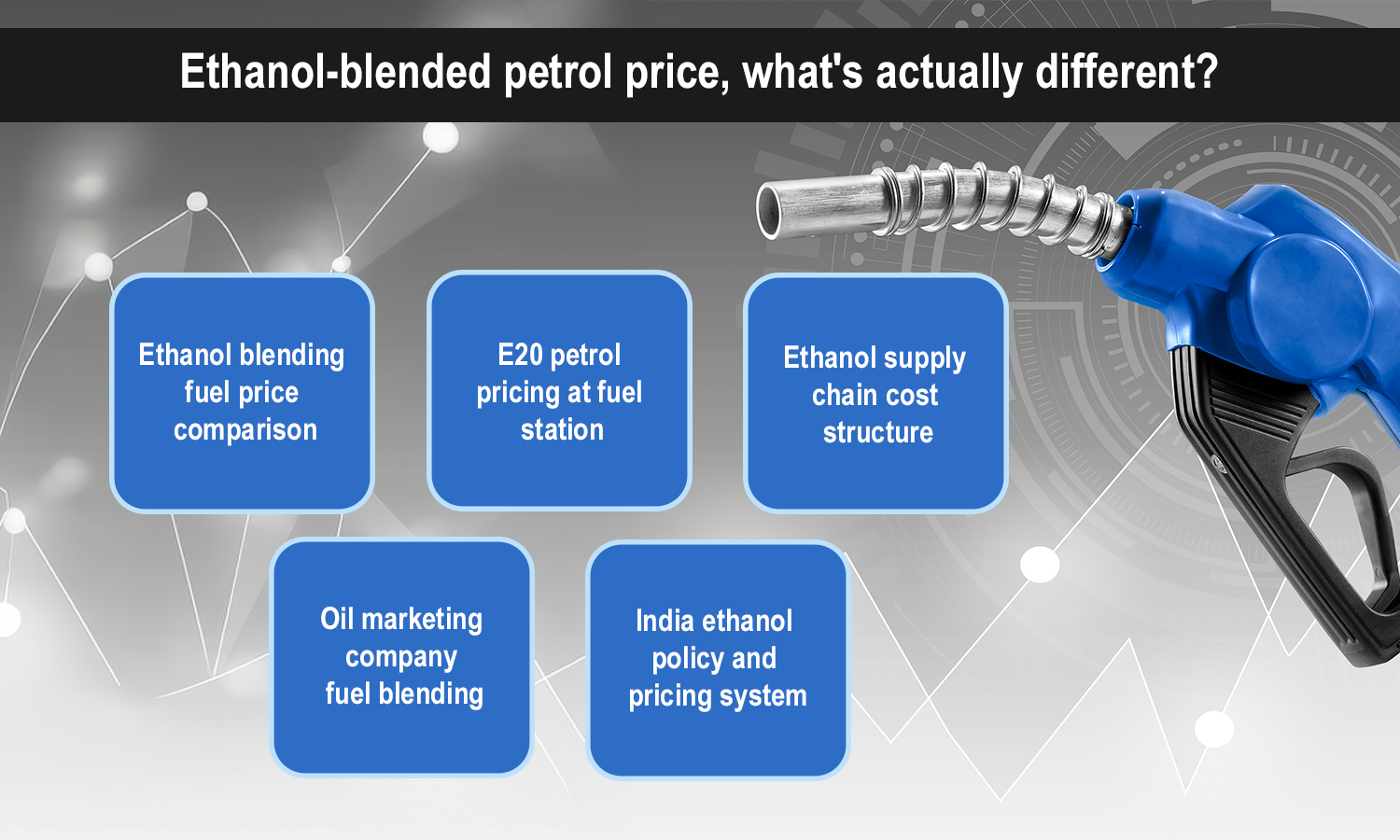
For most consumers, the Ethanol-blended petrol price at the retail outlet is identical to standard petrol. The Centre and the OMCs have deliberately kept the consumer-facing price uniform to avoid signalling complexity at the pump. The differences sit in three places upstream: the administered ethanol procurement price set annually by the Cabinet Committee on Economic Affairs (which varies by feedstock, sugarcane juice, B-heavy molasses, C-heavy molasses, damaged grain, and maize), the central excise duty relief on ethanol meant for blending, and the GST treatment of ethanol for blending versus ethanol for industrial or potable use. Each lever shifts the effective landed cost of a litre of E20 to the OMC, but rarely changes the sticker price for the customer.
Ethanol-blended petrol mileage and density: the engineering trade-off
Here, the cost story becomes physical. Ethanol-blended petrol mileage is marginally lower than pure petrol because ethanol carries roughly two-thirds the energy content of gasoline by volume. Independent studies and ARAI guidance suggest a 1% to 3% drop in fuel economy for E20 in compatible engines, and slightly more in older vehicles not optimised for higher blends. Ethanol-blended petrol density is also higher than that of pure petrol. Ethanol sits at about 0.789 g/cm³, while gasoline ranges between roughly 0.72 and 0.78 g/cm³, which marginally affects volumetric measurement at the pump and the energy-per-litre delivered. The cost implication for the driver is small but real: the same price per litre, slightly fewer kilometres per litre.
Advantages of ethanol-blended petrol, through the cost lens
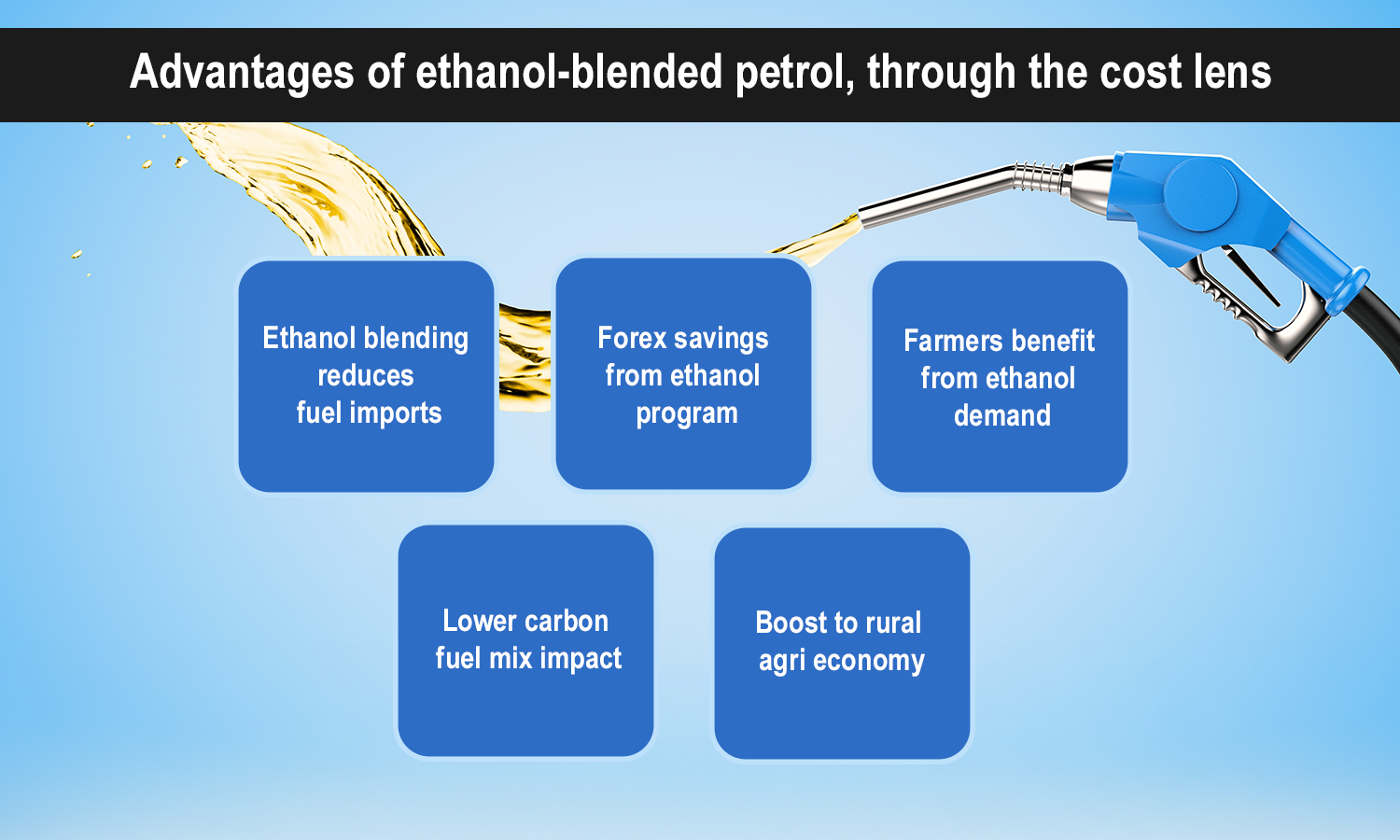
The macro Advantages of ethanol-blended petrol are where the programme earns its keep. India imports nearly 85% of the crude oil it consumes; every litre of ethanol blended is a litre of imported gasoline displaced. Cumulative forex savings since the programme accelerated run into the order of one lakh crore rupees, according to official statements. Farmer payouts for ethanol feedstock have moved into the tens of thousands of crores, directly supporting sugarcane, maize, and damaged-grain economies. The carbon intensity of the transport fuel basket has dropped measurably. These ethanol-blended petrol benefits do not appear on a consumer's receipt, but they show up in the current account, the rural economy, and the country's climate commitments.
Ethanol-blended petrol: disadvantages and safety in India
Honest analysis demands the other side. Ethanol-blended petrol disadvantages include the mileage hit noted above, potential compatibility issues with older fuel system materials (rubber hoses, certain gaskets) in vehicles built before BS-VI norms, and a slightly higher cold-start sensitivity in some climates. On Ethanol-blended petrol safety in India, the regulatory position from MoPNG and ARAI is that E20 is safe for vehicles manufactured after April 2023 to E20 material specifications, and operationally safe for E10-compatible vehicles already on the road. Long-term wear data on pre-2009 vehicles continues to be monitored.
Is ethanol-blended petrol good? The cost-benefit verdict
Is ethanol-blended petrol good for the average vehicle owner in India today? On a pure cost-per-kilometre basis, the answer is "marginally less efficient at the same retail price.
And Is ethanol-blended petrol good for the country's energy economics, agricultural sector, and emissions profile? The answer is clearly yes. The programme is a structural win that absorbs a small individual cost into a large national gain, and the pricing architecture has been deliberately designed so that consumers feel the transition the least.
The Bottom Line
The pricing story of ethanol-blended petrol is a story of strategic absorption, small individual trade-offs in service of a large national transition. As India moves beyond E20 toward higher blends and flex-fuel ecosystems, the cost architecture will keep evolving. The All India Distillers' Association continues to engage with policymakers, OMCs, and member distilleries to ensure that this transition remains economically rational, operationally safe, and equitable across the value chain, from cane farm to fuel tank.
Frequently Asked Questions
Is E20 priced higher than regular petrol at the pump?
No. Retail outlets across India sell E20 at the same notified petrol price as before the rollout. The cost differential sits upstream with the OMCs and is settled through procurement pricing and tax treatment, not the retail receipt.
Will E20 reduce my car's mileage?
A small drop of roughly 1% to 3% is expected in most E20-compatible vehicles. Older, non-compatible vehicles may see a slightly larger gap, depending on engine tuning and age.
Is E20 safe for my existing two-wheeler or car?
Vehicles built to E20 material specifications from April 2023 onward are fully compatible. E10-compliant vehicles can use E20 with limited long-term risk per current regulatory guidance.
Why doesn't ethanol blending reduce my fuel bill if ethanol is cheaper to produce? Because the consumer price is administratively kept uniform. The savings flow into forex relief, farmer income, and emissions reduction, not the pump-side receipt.