India quietly crossed a significant milestone on May 15, 2026. The Bureau of Indian Standards published IS 19850:2026 in the Gazette of India, laying down formal technical specifications for petrol blended with up to 30 percent ethanol. No fuel pump changed overnight. No engine warning light came on. But the regulatory groundwork for the next chapter of India's energy story was formally laid.
Most people driving to a petrol station today will not have heard of this notification. That is precisely why it matters to understand what it says, why it was issued right now, and what it means for the 280 million vehicles on Indian roads.
What IS 19850:2026 Actually Says
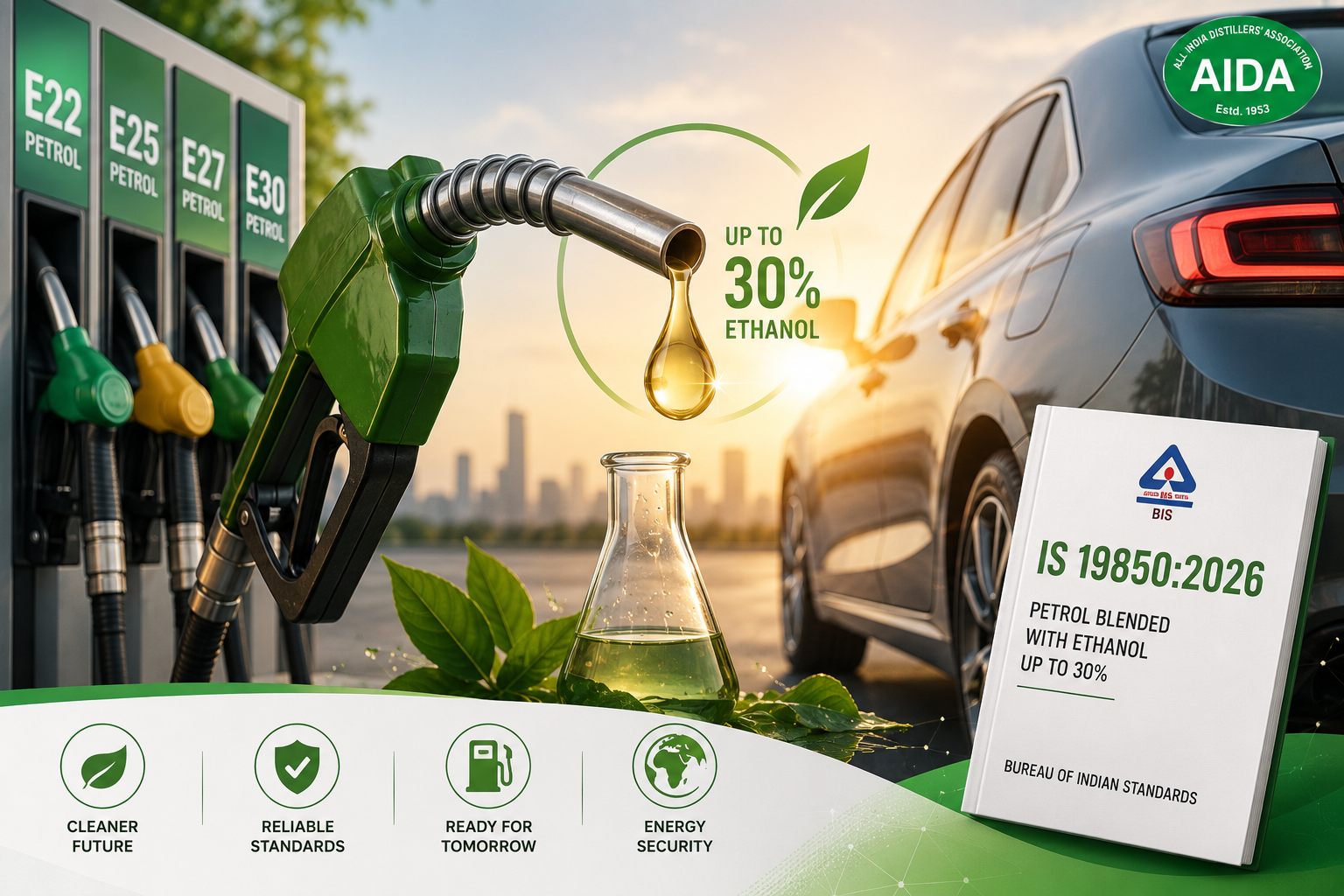
The standard covers four new fuel grades: E22, E25, E27, and E30. Each name is straightforward. E25, for instance, is a blend of 25 percent anhydrous ethanol and 75 percent motor gasoline. The "anhydrous" part matters, since water-free ethanol is the only grade that mixes cleanly with petrol without causing phase separation or fuel system damage.
The standard defines technical and quality benchmarks for each of these four grades, including composition ratios, blending requirements, permissible impurity levels, testing methods, and safety norms applicable to positive ignition engine-powered vehicles, which is the technical name for standard petrol engines that use a spark plug to ignite fuel.
It also specifies octane ratings, sulphur content limits, and vapour pressure requirements for each grade. One operational detail that stands out is that the standard requires fuel dispensing pumps to clearly label these fuels as "E22 PETROL," "E25 PETROL," "E27 PETROL," or "E30 PETROL" so consumers know exactly what they are fuelling their vehicles with.
What the standard does not do is mandate that any of these blends be sold immediately. This is a technical specification document, not a rollout order. The difference is important.
Why This Happened Now
The timing is not coincidental. India completed the mandatory nationwide rollout of E20 fuel on April 1, 2026. Every petrol pump in the country now dispenses E20 as the standard grade. That was a target India had originally set for 2030 and then advanced by five years. Achieving it was a significant operational feat.
Almost immediately after that rollout, the geopolitical situation in West Asia escalated sharply. Following military strikes involving Iran in late February 2026, global crude oil prices spiked and India's fuel import costs rose significantly. India imports more than 85 percent of its crude oil requirement, which means every dollar movement in oil prices ripples directly into the country's foreign exchange outflows and pump prices.
The Ministry of Petroleum and Natural Gas and the Ministry of Heavy Industries began holding urgent discussions with the automobile industry about moving beyond E20 to higher blends, particularly E25. Those discussions made it clear that before any policy shift could happen, the technical standards needed to exist first. IS 19850:2026 is the answer to that requirement.
The Larger Context: India's Ethanol Journey So Far
To understand why this standard matters, it helps to look at where India has come from on ethanol blending.
The Ethanol Blended Petrol programme has been running for over two decades, but the ambitions were modest for most of that period. In 2013-14, the national average blending rate was barely 1.5 percent. By 2021-22, it had crossed 10 percent, a level that previously seemed difficult to achieve. India then crossed the E20 threshold in 2025, ahead of the revised target, saving roughly Rs 1.65 lakh crore in crude oil import costs over the life of the programme.
The domestic ethanol production capacity now stands at around 19 to 20 billion litres annually. But here is the thing: demand under the E20 programme is estimated at only about 11 billion litres in the current ethanol supply year. There is a significant surplus production capacity sitting idle, and that surplus is one more reason the industry and government are thinking about pushing ethanol content higher.
Ethanol in India is produced primarily from sugarcane molasses, sugarcane juice, damaged food grains, and increasingly from maize. Every additional percentage point of ethanol in the national fuel mix means more money flowing to farmers, less money flowing to oil exporters, and fewer tonnes of carbon dioxide going into the atmosphere.
What the Auto Industry Is Actually Worried About
Here is where things get complicated. The auto industry's reaction to IS 19850:2026 has been cautious at best and alarmed at worst.
India has roughly 240 million two-wheelers and 40 million passenger cars on the road. Most vehicles sold in the last two to three years have been engineered for E20 compatibility. But the bulk of the existing vehicle fleet, particularly older two-wheelers and entry-level cars, was designed for much lower ethanol content. Moving to E25 or E30 would mean these vehicles are running on fuel they were never designed for.
Ethanol has about 33 percent less energy per litre than petrol. Higher ethanol content means slightly lower fuel economy per litre, though the per-kilometre cost impact depends on the price differential between ethanol and petrol. More critically, ethanol is corrosive in ways that petrol is not. Fuel lines, rubber gaskets, fuel pump components, and carburettor parts in older vehicles can degrade faster when exposed to high ethanol concentrations.
Multiple automobile industry executives have publicly said that extensive government-led testing needs to happen through 2026 before any transition to E25 is mandated. Automakers have specifically warned that the jump from E20 to higher blends is not trivial from an engineering standpoint, and that the existing vehicle fleet needs careful evaluation. Customer awareness, appropriate fuel pricing, and clear guidance from manufacturers were identified as essential prerequisites for any smooth transition.
The government's own position has been that any move beyond E20 would involve careful calibration and extensive consultations with automakers, feedstock suppliers, research agencies, oil companies, and ethanol producers. IS 19850:2026 is consistent with that approach. It creates the framework without forcing a premature rollout.
What the Ethanol Industry Wants
On the other side of this debate, India's distilleries and ethanol producers are enthusiastic about the direction the policy is heading.
The All India Distillers' Association welcomed IS 19850:2026 as a significant and timely step. The association has argued that E25 is a viable near-term option that would help absorb the current surplus of ethanol production capacity while reducing crude oil imports. Beyond that, AIDA has been pushing for a long-term transition to E85 and eventually E100 fuels, which would require flex-fuel vehicles capable of running on a wide range of ethanol-petrol blends.
Several automakers have already showcased flex-fuel compatible vehicles in India over the past few years, anticipating exactly this kind of policy direction. Flex-fuel engines can run on any blend from standard petrol to E85 or even pure ethanol. They are common in countries like Brazil, where E27 has been the standard fuel for years and automakers including Toyota, Honda, and Hyundai operate without compatibility issues.
Brazil is actually the most frequently cited model when Indian policymakers discuss higher ethanol blending. The country has run on E25 or higher for decades, its vehicle fleet has been engineered accordingly, and its sugarcane-based ethanol industry provides both energy security and a significant agricultural income base.
The Infrastructure Question Nobody Should Overlook
Beyond vehicles, there is a significant infrastructure challenge that IS 19850:2026 implicitly triggers.
Oil marketing companies will need to invest in dedicated storage tanks at fuel pumps to store higher-blend fuels separately from standard petrol and E20. Dispensing infrastructure will need modification. The supply chain from distilleries to blending plants to fuel pumps will need to be adapted for higher ethanol volumes. Nationwide consistency in fuel quality will need to be ensured before any retail rollout, since inconsistent blends reaching consumers would cause real damage to both vehicles and public trust in the programme.
None of this is insurmountable. India has demonstrated over the last decade that it can build ethanol supply chains at scale. But it does mean that the gap between notifying a standard and actually selling the fuel at pumps is not a matter of months.
What Comes Next
IS 19850:2026 was notified under Rule 15(1) of the Bureau of Indian Standards Rules, 2018. It took effect from May 15, 2026. In the same gazette notification, BIS also issued revised standards for dimethyl ether blended LPG and a range of other industrial specifications, signalling that this was part of a broader regulatory exercise rather than a one-off announcement.
The Inter-Ministerial Committee of NITI Aayog is expected to submit a report on the future of ethanol blending in India, and its findings will heavily influence whether and when the government moves to mandate E25. The current roadmap commits to E20 until October 31, 2026, with decisions on further blending to follow from that report and stakeholder inputs.
Why This Standard Is More Important Than It Looks
A technical standards notification does not make headlines the way a fuel price hike does. But IS 19850:2026 is, in practical terms, the necessary first step before any of the bigger policy moves can happen.
Without a formal standard, oil companies cannot benchmark a product. Automakers cannot certify vehicle compatibility. Testing agencies have no reference point for quality checks. Component suppliers have no specification to design against. A BIS standard transforms a policy aspiration into something that engineers, procurement teams, and compliance officers can actually work with.
India spent years building the supply chain, regulatory framework, and vehicle manufacturing ecosystem for E20. IS 19850:2026 begins that same process for the next generation of blends. It is a quiet document, but it is doing important work.
The question now is not whether India will move beyond E20. That direction is clear. The question is how quickly the vehicle fleet, the fuel infrastructure, and consumer awareness can align to make the transition smooth. The standard is written. The rest of the work starts now.
IS 19850:2026 was published in the Gazette of India by the Bureau of Indian Standards on May 15, 2026. It covers E22, E25, E27, and E30 fuel specifications for positive ignition engine-powered vehicles and was issued under Rule 15(1) of the Bureau of Indian Standards Rules, 2018.